A Dental Floss Keychain is a compact oral-care tool designed for people who need quick access to floss outside the bathroom. It usually combines a small floss dispenser with a keyring, case, or protective capsule. The design fits inside a pocket, handbag, gym bag, or car console. Some models use individual floss picks. Others hold a short roll of dental floss that slides through a cutting edge.
The mechanism is simple. You pull out a measured length, guide it gently between two teeth, and cut the strand against the built-in edge. The keychain protects the floss from loose dirt and helps prevent forgotten routines. It is useful after lunch, coffee, travel, or a meal with fibrous food. Small enough to carry.
Dr. Matthew Messina, an American Dental Association consumer advisor, has said, “Flossing is still the best way to clean between your teeth.” A Dental Floss Keychain supports that habit, but it does not replace brushing, fluoride toothpaste, or professional dental care. It also cannot correct poor technique. Pressing floss forcefully into the gums may cause bleeding or irritation. That detail is easy to overlook. Users should choose a clean, durable design and replace damaged or contaminated floss. The product seems simple, yet comfort, hygiene, and reliable cutting matter. A keychain can encourage consistency, though it cannot guarantee it.
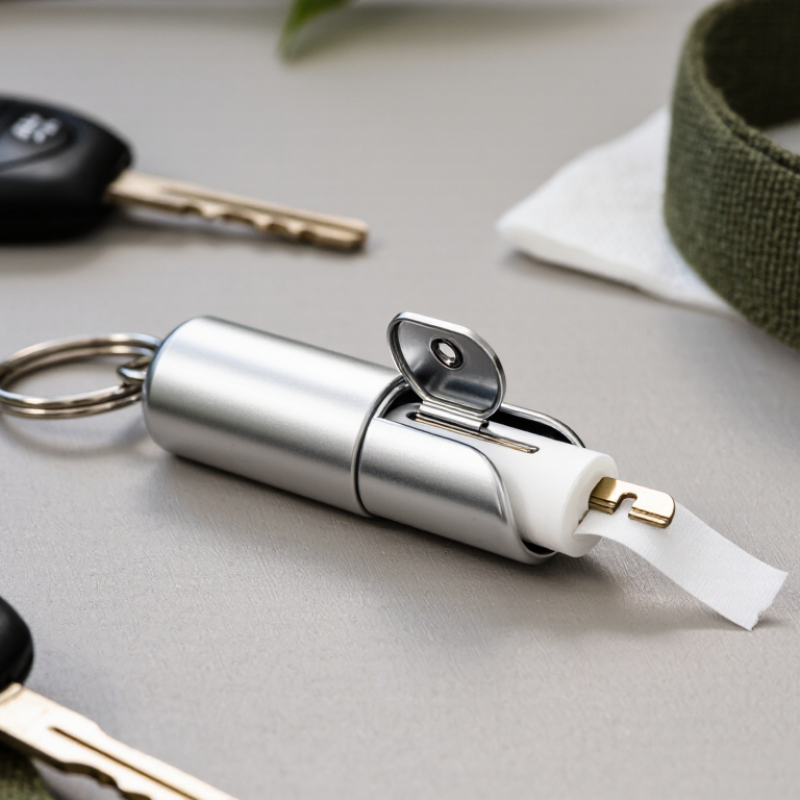
A dental floss keychain is a small, portable tool for cleaning between teeth away from home. It usually combines a compact floss dispenser, a reusable handle, or a covered floss pick. A short metal ring attaches it to keys, a bag, or a travel pouch. The design keeps floss within reach after meals, during work, or while traveling.
Its operation is simple. Pull floss from the built-in spool, or remove a preloaded pick from its case. Guide the floss gently between two teeth. Curve it around each tooth, then move it below the gumline without snapping.
Some models use replaceable heads. Others require fresh floss each time. The mechanism is convenient, but small cases can collect moisture and debris. Cleaning matters.
The World Health Organization’s Global Oral Health Status Report (2022) estimates that oral diseases affect nearly 3.5 billion people worldwide. Untreated cavities in permanent teeth affect about 2.5 billion people. In the United States, CDC data from 2015–2018 found untreated cavities in roughly one in four adults aged 20–64. Daily interdental cleaning can support plaque control, while brushing alone may miss narrow spaces. A keychain tool cannot repair decay or replace professional care. It may also feel awkward at first. Technique improves with practice. People with braces, bleeding gums, or dental restorations should ask a dental professional which floss design fits safely.
A dental floss keychain is a compact interdental cleaner designed for use away from the bathroom. Its portable flossing mechanism usually stores a short floss spool inside a small case. When the lid opens, the user pulls out a measured strand. A built-in guide keeps the floss aligned, while a cutting edge separates the used section. Some designs use replaceable cartridges, but the basic principle remains simple: pull, guide, cut, and discard.
The mechanism works best when the floss stays taut. Gently pressing it between teeth reduces snapping and protects the gums. Curve the strand around each tooth, then move it below the gumline with light strokes. This detail matters because plaque often collects where a toothbrush cannot reach.
The Centers for Disease Control and Prevention reports that about 46% of adults aged 30 or older show signs of gum disease, while around 26% of adults have untreated cavities. A keychain can make daily cleaning more convenient, but convenience does not guarantee correct technique.
Small enough for a pocket.
The World Health Organization’s 2022 oral health report estimates that nearly 3.5 billion people live with oral diseases. That figure gives portable hygiene tools real practical relevance, especially during travel or long workdays. Still, a floss keychain may hold too little floss for repeated use, and its cutter can become less reliable over time. Users should replace damaged parts and avoid reusing contaminated floss. It is a useful aid, not a substitute for professional dental care or an honest look at personal technique.
A dental floss keychain is a compact oral-care tool designed for use outside the bathroom. Its main body usually contains a small spool of waxed or unwaxed floss. A rotating wheel releases a measured length, while a narrow exit slot guides the strand. Some designs include a built-in cutter. Others use a disposable floss pick stored inside the case.
The key components determine both hygiene and durability. The floss is commonly made from nylon or polytetrafluoroethylene (PTFE), materials chosen for tensile strength and smooth movement between tight teeth. Nylon may feel slightly textured, while PTFE slides more easily but can feel less grippy. The housing is often polypropylene or ABS plastic, combining low weight with impact resistance. A stainless-steel key ring adds portability, although its hinge can loosen after repeated contact with moisture. Small details matter.
The World Health Organization’s 2022 Global Oral Health Status Report estimates that oral diseases affect nearly 3.5 billion people worldwide. It also reports about 2.5 billion untreated cases of caries in permanent teeth. A floss keychain cannot replace brushing or professional care, but it can reduce the excuse of being unprepared. Use gentle pressure and curve the floss around each tooth. Snapping it downward may injure gum tissue. The concept is practical, yet not flawless. Dust can enter the dispenser, and users may forget to replace contaminated floss. A washable case and sealed refill would improve reliability.
| Component or Feature | Typical Material | Typical Specification | How It Works | Practical Consideration |
|---|---|---|---|---|
| Floss strand | Nylon, PTFE, or expanded PTFE | Usually a thin, smooth strand supplied in a compact length | Slides between teeth and along the gumline to remove plaque and food particles that a toothbrush may miss | Nylon may be textured or waxed; PTFE generally glides easily through tight contacts |
| Floss storage chamber | Polypropylene, ABS plastic, or stainless steel | Small enclosed compartment sized for a limited supply of floss | Protects the unused floss from dirt, moisture, and tangling while the keychain is carried | A sealed or close-fitting cover offers better protection than an open holder |
| Dispensing outlet | Molded plastic or corrosion-resistant metal | A narrow opening that guides the floss outward | Keeps the strand aligned and helps prevent the stored floss from pulling out as a tangled bundle | Smooth edges reduce abrasion and make the floss easier to pull |
| Cutting edge | Hardened stainless steel or another durable metal | Compact serrated or sharpened edge integrated into the dispenser | Allows the user to separate the required length of floss without carrying scissors | The cutting area should be covered or recessed when not in use |
| Protective cover | Polypropylene, ABS, silicone, or metal | Snap-fit, sliding, hinged, or screw-on closure | Covers the outlet and cutting edge during storage or transport | A secure closure helps maintain hygiene and prevents accidental snagging |
| Keychain attachment | Zinc alloy, stainless steel, or plated steel | Split ring, clip, or short connecting loop | Connects the floss dispenser to keys, a bag, or a travel pouch | Metal hardware should resist bending, rust, and repeated opening |
| Housing dimensions | Lightweight plastic or metal shell | Commonly about 45–75 mm long, 20–35 mm wide, and 8–18 mm thick | The compact form makes the dispenser suitable for pockets, handbags, and travel kits | Exact dimensions vary according to the floss capacity and attachment design |
| Operating method | Mechanical, manually operated design | No battery, motor, or electronic control is normally required | Open the cover, pull out an appropriate length, cut it, and use the floss with clean hands | The dispenser provides portability and controlled access rather than powered cleaning |
| Hygiene and maintenance | Water-resistant plastics or corrosion-resistant metals | Wipe-clean exterior; replace floss when the supply is depleted or contaminated | A closed body limits exposure, while regular cleaning helps keep the exterior suitable for daily carrying | The device should not be shared unless the floss is dispensed without direct contact |
Note: Specifications are representative ranges for compact dental floss keychains; individual designs may differ in size, capacity, closure type, and material composition.
A dental floss keychain is a small, portable holder or dispenser attached to a key ring. Many models store floss inside a compact case, while others hold a pre-cut strand. Its purpose is simple: make cleaning between teeth easier when you are away from home. The case protects the floss from dust, but it does not replace hand washing or regular dental care.
Wash your hands and inspect the device before using it. If it has a dispenser, pull out about 30 to 45 centimeters of floss. Use the built-in cutter, if available. For a pre-cut design, remove one clean strand without touching nearby floss.
Wrap the ends around your middle fingers, leaving a few centimeters between them. Guide the floss gently between two teeth. Do not force it downward, especially when the contact feels tight.
Curve the floss around one tooth in a C shape. Move it up and down against the tooth surface, then repeat on the neighboring tooth. Use a fresh section for each space. Be gentle near the gumline.
Bleeding can occur when gums are inflamed, but repeated bleeding deserves professional advice.
I once rushed this step and snapped the floss against my gums. It was uncomfortable and unnecessary.
Replace frayed floss, avoid sharing the tool, and clean the case according to its instructions. Not every keychain design is equally easy to grip, so practice slowly before relying on it during travel.
A dental floss keychain is a small, portable tool that stores or dispenses floss from a case attached to keys or a bag. Its mechanism is simple: pull out a measured length, guide it gently between the teeth, and cut it with a built-in edge. The compact design can make flossing easier after lunch, travel, or a long workday. In practice, visibility matters. A bright case and a firm cutter may prevent the tool from being forgotten.
Its main benefit is convenience, not superior cleaning. Regular flossing can remove plaque and food particles from areas a toothbrush misses. The keychain also encourages short, realistic habits. However, its floss may be thin, difficult to grip, or unsuitable for wide spaces, braces, bridges, or sensitive gums. A dental professional can recommend floss threaders, interdental brushes, or other options when needed. Bleeding that continues after several days should not be ignored.
Hygiene needs attention. Wash and dry your hands before use, and keep the case closed when it is not needed. Do not share the same floss or let used floss touch the remaining strand. Moisture trapped inside a pocket can create an unpleasant environment, so inspect the dispenser and replace it when the floss becomes dirty, frayed, or damp. The cutter also deserves cleaning. It is easy to assume a keychain tool is automatically hygienic, but portability can expose it to keys, coins, and bathroom surfaces. It supports brushing; it does not replace it.
A dental floss keychain is a compact floss holder or floss container designed to make interdental cleaning more convenient while traveling. It may improve access and portability, but it does not replace proper flossing technique or professional dental care.
The chart shows commonly recommended daily frequencies: brush teeth twice daily and clean between teeth once daily. Single-use floss should be discarded after use, while reusable holders should be cleaned and dried regularly to reduce contamination. Replace floss if it becomes frayed, dirty, or damaged.
Guidance basis: American Dental Association recommendations for brushing twice daily and cleaning between teeth once daily. Individual dental advice may vary.